
Brian Fuller’s career traces a throughline from battlefield analyst to academic leader, with one constant companion: i2 Analyst’s Notebook (i2). In this article, we learn about his impressive career, from tracking Iranian spies in Iraq to teaching the next generation intelligence analysts. i2 has been by his side every step of the way.
Over 24 years in uniform and now as executive director of Mercyhurst University’s Center for Intelligence Research, Analysis, and Training (CIRAT), in Pennsylvania, Brian credits i2 with changing how analysts collect, visualize and communicate intelligence. It has certainly been instrumental in helping him meet his objectives, from tactical counterintelligence operations in Iraq to strategic order-of-battle work in Korea and, most recently, applied intelligence work with students and real-world clients.
Brian first came across i2 Analyst’s Notebook during his reclassification to an all-source analysis role in the US Army in 2007. He was immediately impressed by its ability to take messy, disparate information and clearly visualize a situation. “It was a revolutionary knowledge graph type of tool,” he recalls. “It enabled analysts to display the information in a knowledge graph that we could then share across multiple domains and put in front of our decision makers.”
.png?width=252&height=252&name=Brian%20Fuller%20(1).png)
Deployed to counterintelligence operations in Iraq in 2008, Brian used Analyst’s Notebook to reveal insider threat networks that would otherwise have remained hidden, he says, in reams of notes and reports. In one situation, Analyst’s Notebook helped Brian and his team identify a cleaning crew tied to a hostile network of spies operating in the country, so-called ‘collectors’, and feeding information back to Iran.
“We started to build the entities of who they might be in the network, who they're reporting to, and who they might be using as sources, and figuring out what they’re trying to collect,” he says. “With i2, we really had a comprehensive knowledge graph.”
That graph made it possible to spot linkages with phone numbers, family ties and employer relationships that traditional, manual analysis would likely miss. “We essentially get down to a pool of potential collectors, because even though they're cleaning personnel, at that point, they are considered insider threats, right, because they're spying for an insurgent group collecting information to give to Iran.”
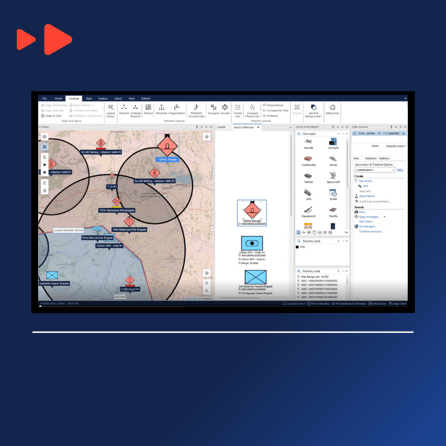
In Iraq, Analyst’s Notebook helped Brian and his team understand the operational environment from a threat perspective, understand the insider threat, and identify the potential insurgent or terrorist groups that were a risk to the US on the ground.
Brian’s career progressed from tactical counterintelligence to broader operational intelligence, and his use of i2 evolved with those responsibilities. While serving as First Sergeant of a military intelligence company (MICO) at Fort Carson, Colorado, preparing to deploy to Kuwait, Brian pushed i2 beyond tactical usage to support the Military Decision-Making Process (MDMP).
The software allowed analysts to craft an order-of-battle and represent adversary capabilities in a format commanders could quickly digest.
“I always say the decision maker has 30 seconds for you to show them or tell them what's most important, what is it that they need to know,” says Brian. “Well, i2 gave me the ability to take a large amount of data, put it into a knowledge graph that could easily be digested by a decision maker or a commander in a real time environment and be actioned upon quickly on the ground. You had something that could be easily ingested and used on the battlefield.”
Move on to 2017, now with the US Forces Second Infantry Division in South Korea as a Senior Intelligence Sergeant, Brian and his team used i2 to rapidly build and maintain an up-to-date order-of-battle and capability database on North Korean forces, enabling analysts and commanders to compare systems, units and personalities at a glance. “We used i2 to understand not just their capability in North Korea, their key personalities, their key leaders, but also to understand vulnerabilities in the DMZ (Korean Demilitarized Zone),” he said, underscoring the tool’s versatility across theaters and problem sets.
Analyst’s Notebook was also ensuring the unit was avoiding institutional memory loss across rotations. Charts and entity cards retained provenance and context so successive analysts could pick up investigations and track seamlessly.
i2 Analyst’s Notebook had become a trusted platform for handling sensitive regional intelligence.
Since joining Mercyhurst in late 2019 as Director of Operations of the intelligence studies department, and now currently serving as the Executive Director for the CIRAT, Brian has integrated his operational lessons into an academic and applied-research setting. CIRAT now blends students from intelligence studies, data science, cybersecurity, criminal justice, political science and communications to tackle real client work – government, private sector, law enforcement, NGOs — using i2 Analyst’s Notebook as the center’s visual analytics tool. “I believe i2 is one of the best ways for us to build out the networks, find the operational patterns,” Brian says.
Under his direction, the center has used the platform to support competitive business intelligence, supply-chain risk analysis, law enforcement, and anti-human-trafficking operations with partner NGOs.
By training with i2 and doing applied projects, students gain credentials and practical experience that prepare them for analyst roles in defense, law enforcement, NGOs and industry. Exposing future analysts to tools like Analyst’s Notebook “is exposing i2 every year to a potential 100 to 150 new analysts going into employment”.
When asked why i2 still stands out among newer competitors, Brian points to three factors: capability, customer partnership and trust. Technically, i2’s knowledge-graph approach and refined visualization remain exceptional for link-and-pattern analysis. Equally critical is the vendor relationship and academic access: “The relationship that we have with you is a differentiator between other vendors,” he said, noting the value of licensing and training in academic environments.
Finally, data control matters, says Brian. He is explicit about his preference to retain custody of sensitive information: “I like to control my own data.”
Brian’s story is a practitioner’s endorsement of i2’s Analyst’s Notebook in modern intelligence: a tool that speeds analysis, preserves institutional memory and prepares the next generation of analysts.
From uncovering insider threats in Iraq to building curriculum and client services at Mercyhurst, Brian has demonstrated that i2 Analyst’s Notebook can turn data into decisions in some of the world’s most challenging environments.
See how i2’s market-leading solutions are used globally in some of the most demanding operational environments. Request a demo to explore how they support real-world decision-making.


.png?width=150&height=75&name=Cyber%20Ess%203%20MONO%20(1).png)


© 2026 i2 Group / N. Harris Computer Corporation. All trademarks owned by N. Harris Computer Corporation.
1 Cambridge Square, Milton Avenue, Cambridge, CB4 0AE, UK