
Correctional leaders across the world face a growing challenge. While prisons are responsible for maintaining security, protecting staff, supporting rehabilitation and safeguarding society, organised crime has evolved faster than many correctional systems.
Today, criminal networks continue to operate even when key members are incarcerated. Through visitors, illicit communications, financial transactions, external associates and increasingly sophisticated methods of coordination, offenders can remain connected to criminal enterprises beyond prison walls. A prison sentence no longer guarantees disruption of criminal activity. In many cases, it simply changes how that criminal activity is transported and coordinated into and out of prisons.1
The consequences are visible across many correctional systems:
At the same time, prisons face increasing operational pressures. Facilities are often overcrowded, staff turnover remains high, and intelligence analysts are expected to process growing volumes of information from incident reports, visitor records, communications, financial transactions and external agencies.
The challenge is rarely a lack of information.
The challenge is understanding what that information actually means.
A fight on one wing may appear to be an isolated incident. A suspicious visitor may seem insignificant. An unusual financial transaction might generate little concern on its own.
Viewed together, however, these events may represent early indicators of a larger criminal network, an escalating gang conflict or a coordinated threat developing both inside and outside the prison – or even across countries, as described in this article.2
The United Nations Office on Drugs and Crime (UNODC) recognises prison intelligence as a critical component of modern prison security and management. Its Handbook on Dynamic Security and Prison Intelligence highlights the importance of dedicated prison intelligence capabilities, structured intelligence processes and multi-agency collaboration to understand and prevent threats before they escalate.
For senior leaders, this represents a strategic shift.
Traditional correctional models are often reactive. Intelligence-led prisons enable organisations to become proactive.
Instead of responding to incidents after they occur, intelligence teams can identify emerging risks, understand criminal relationships, prioritise threats and support earlier intervention.
This is why more correctional services are establishing dedicated intelligence units and formal intelligence operating models. These units collect, evaluate, analyse and disseminate information so decision-makers can understand the wider picture rather than isolated events.
The goal is not simply to collect more information.
The goal is to transform information into actionable intelligence.
Most correctional organisations already possess valuable information.
Prison management systems contain offender records and incident reports. Visitor management systems track external contacts. Financial systems record inmate transactions. Communication monitoring tools capture phone and messaging activity. Law enforcement agencies hold valuable intelligence about criminal networks operating outside the prison.
The problem is that these sources often exist in isolation.
When data remains fragmented, critical connections remain hidden.
Correctional leaders need the ability to understand the bigger picture to reduce risk towards staff, prisoners and society by getting answers on:
The answer lies in connected intelligence.
Connected intelligence creates a single operational picture by combining information from multiple sources and presenting it in a form that analysts, investigators and decision-makers can understand and act upon.
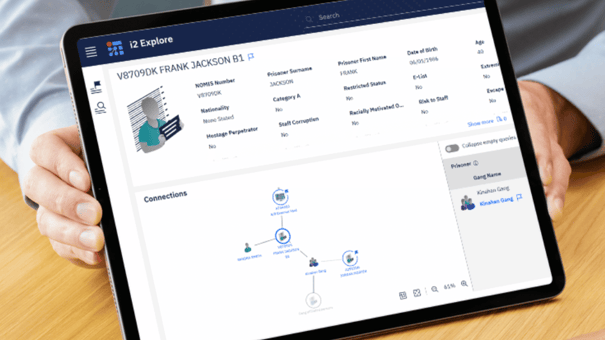
For more than ten years, correctional services across multiple countries have used i2 technology to support prison intelligence functions and intelligence-led investigations. Our focus has never been on replacing existing prison systems. Instead, we help correctional organisations connect the intelligence they already possess and reveal the criminal networks hidden within it.
The i2 Prison Intelligence Solution enables correctional organisations to establish a trusted intelligence picture across their facilities while supporting the workflows of analysts, investigators and operational leaders.
This allows intelligence teams to:
Most importantly, it helps create safer prisons for staff and offenders while contributing to safer communities beyond prison walls.
Modern prison intelligence requires a broader perspective than any single system can provide.
Leading correctional organisations are increasingly combining information from:
Analysts no longer need to spend valuable time accessing, searching and consolidating information from these sources when it can be fused into a single intelligence environment, providing an instant 360-degree understanding of incidents, individuals and criminal networks.
An assault no longer appears as a standalone event.
It becomes part of a wider intelligence picture that may reveal gang affiliation, financial relationships, external facilitators, previous incidents and emerging threats.
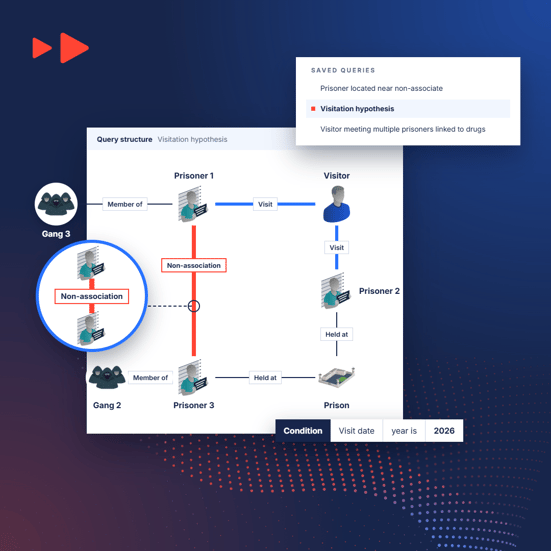
Figure 2: Analysts can define complex queries in a graphical user interface
This broader context allows correctional leaders to move from reactive incident management to proactive threat management.
Criminal networks are becoming more connected, more adaptive and more resilient.
Correctional organisations must do the same.
Senior leaders who invest in intelligence capability today are positioning their organisations to better understand risk, protect their staff, prevent violence and disrupt organised crime before it escalates.
The future of prison security is not built on collecting more information.
It is built on connecting information, generating intelligence and enabling better decisions.
Because safer prisons create safer communities.




© 2026 i2 Group / N. Harris Computer Corporation. All trademarks owned by N. Harris Computer Corporation.
1 Cambridge Square, Milton Avenue, Cambridge, CB4 0AE, UK
