.png)
Recent reporting from Dansk Politi highlights how Danish law enforcement is exploring new analytical platforms and monitoring practices to address a troubling spike in homicides against women committed by current or former partners.
The underlying premise is both sobering and important: violent crimes in close relationships rarely occur without warning. In many cases, they are preceded by identifiable indicators that, if systematically captured and analysed, could enable earlier intervention and potentially save lives.
This thinking resonates strongly with conversations I have recently had with other law enforcement agencies facing different, but structurally similar, strategic challenges. One such example is the emerging focus on crime-as-a-service in the Nordics, where young individuals are recruited by organized crime groups to carry out assassinations against rival gangs. Here too, recruitment and escalation tend to follow discernible patterns across people, events, communications, and transactions.
Across these diverse problem sets, the analytical requirement is fundamentally the same: the ability to build a thematic analysis platform that can systematically monitor indicators, analyze networks and behaviors, and support timely, intelligence-led decision-making.
In this context, a thematic analysis platform is not a single-purpose tool or a static repository. It is an analytical capability designed to support sustained focus on a defined strategic theme, whether that is violence in close relationships, crime-as-a-service, illicit arms trafficking, or complex financial crime. At its core, it enables agencies to systematically capture weak signals and indicators over time, structure them within a common data model, and analyse how people, events, behaviours, and transactions interact as part of a broader pattern.
Crucially, a thematic analysis platform supports both continuity and adaptability. Strategic threats rarely present as isolated cases; they evolve across jurisdictions, data sources, and investigative phases. The platform must therefore allow analysts to move seamlessly from individual data points to networked insight, from historical context to emerging risk, and from descriptive analysis to forward-looking intelligence. This requires persistent data, flexible schema, and the ability to overlay analytical techniques (link analysis, temporal analysis, and behavioural patterning) without losing analytical rigour or auditability.
This is precisely the role that i2 iBase has fulfilled for more than two decades. Rather than being optimised for a single crime type or investigative workflow, i2 iBase provides a stable, extensible foundation on which strategic focus areas can be built and sustained. Organizations use it to define what matters for a given theme - key entities, indicators, relationships, and events - and to ensure those elements are consistently captured and analysed over time, even as priorities evolve.
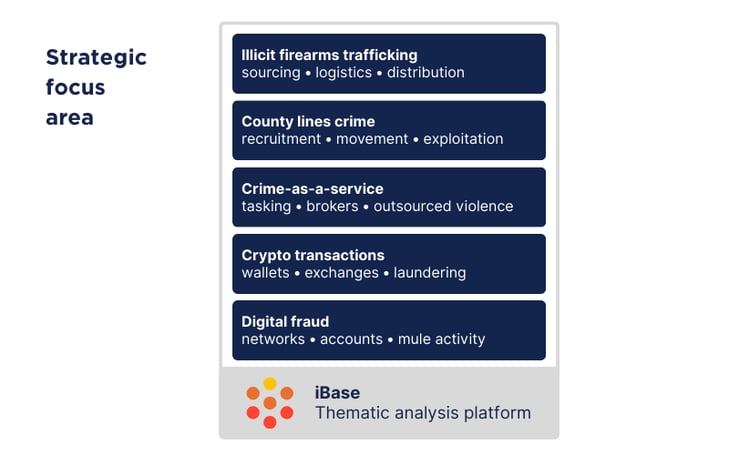
Its long-standing adoption by law enforcement and intelligence agencies reflects this strength. From its use by Europol in tackling illicit arms trafficking, through to modern applications in digital fraud and cryptocurrency-enabled crime, i2 iBase has repeatedly demonstrated its ability to underpin thematic analysis at scale. In doing so, it enables agencies not just to respond to incidents, but to maintain strategic oversight, identify escalation pathways, and support intelligence-led intervention where it can have the greatest impact.
In many organizations - and often across collaborating countries - i2 iBase is already deployed and actively used. This significantly lowers the barrier to establishing a new thematic analysis platform. Analysts and administrators are familiar with the technology, and in many cases, law enforcement agencies manage and develop i2 iBase databases independently, without reliance on external vendors.
The i2 iBase licensing model allows organizations to rapidly deploy new database instances when a new strategic focus area emerges. Licensing is based on the number of users rather than the number of database instances, enabling fast and cost-effective scaling without procurement delays.
This means that the cost is not dependent on the number of deployments of i2 iBase, but on the number of concurrent users.
i2 iBase does not require specialized or proprietary database technology. It can operate on Microsoft Access, Microsoft SQL Server or Azure SQL managed instance; platforms already available within most law enforcement IT environments. This simplifies both deployment and long-term maintenance. This is valuable especially in time sensitive analysis projects where you don’t have time for lengthy procurement and deployment cycles.
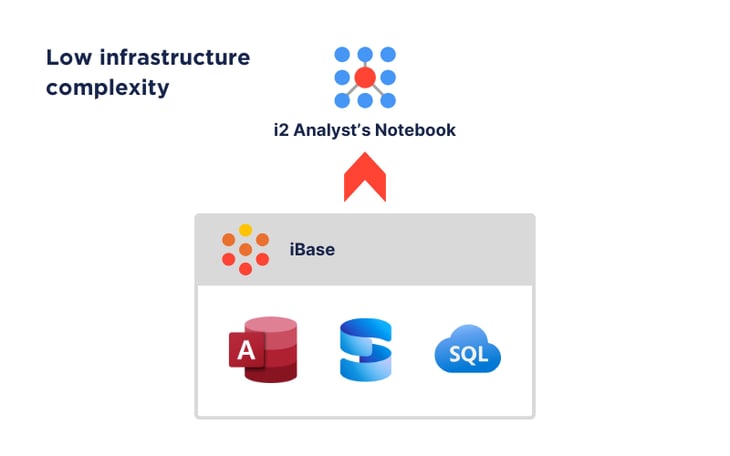 Relational data with network intelligence
Data in i2 iBase is stored in a relational database while being modeled in a graph-like structure. This provides the analytical benefits of network analysis while preserving full ownership, accessibility, and flexibility of the underlying data—without vendor lock-in or imposed limitations.
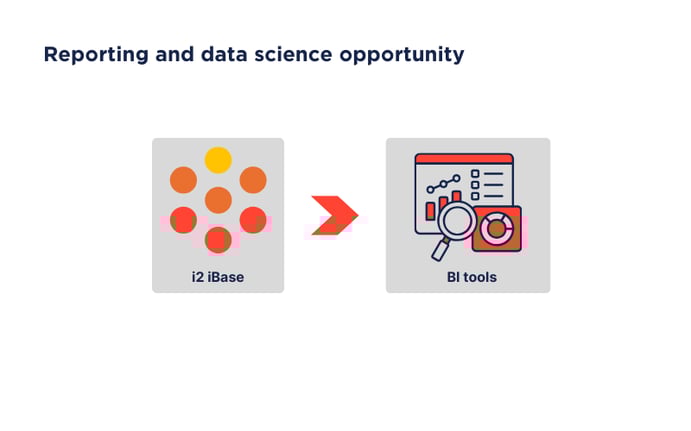
This means from a thematic perspective that you can integrate third-party Business Intelligence (BI) and Analytical reporting applications such as Microsoft PowerBI, Qlik, Tableau and open source data science tools to gain more insights from the data collected by i2 iBase.
From an operational perspective, i2 iBase consistently meets the core requirements associated with thematic analysis platforms.
Questions around scalability often arise. In practice, when deployed on Microsoft SQL Server, i2 iBase has demonstrated the ability to support very large datasets. We currently see implementations exceeding 20 billion records. That said, many strategic focus areas are deliberately scoped, meaning data volumes are often significantly lower.
i2 iBase can be configured to automatically ingest data from source systems such as case management systems, criminal records, and ANPR platforms. In international collaboration contexts, intelligence is frequently exchanged via spreadsheets - another format that i2 iBase can ingest automatically. For manual monitoring and submissions, i2 iBase provides structured datasheets that support consistent and efficient analyst input.
Different strategic focus areas often require different data models. Large enterprise platforms frequently impose financial, technical, or organizational constraints on data model customization—often requiring external consultants, impacting data pipelines, or affecting unrelated business areas. i2 iBase allows teams to tailor data models locally to meet specific strategic objectives without disrupting the broader organization.
Effective thematic analysis depends on powerful search and exploration capabilities. i2 iBase provides:
In addition, many customers integrate i2 iBase data with familiar tools such as Microsoft Excel or Power BI for reporting and broader analytical use.
i2 iBase supports proactive alerting and scored matching. Analysts can define criteria, such as repeated incidents of concern combined with known violent criminal history, and receive alerts when thresholds are met. Scoring models can be scheduled to identify individuals or entities at highest risk, enabling analysts and decision-makers to focus attention where it matters most.
Whether the challenge is preventing domestic violence, disrupting organized crime recruitment, or addressing emerging forms of criminality, the underlying analytical need is remarkably consistent. Organizations that already use i2 iBase, or collaborate with those that do, often find they already have much of the required capability at hand.
If your organization is establishing a new strategic focus area, it is worth reaching out to your existing i2 users, partner agencies, or neighboring countries. Chances are they are already tackling similar challenges - or can help you get started quickly and effectively.
About the author - Martin Kragh
Martin worked as a law enforcement officer and analyst at the Danish National Police for 16 years before joining i2 Group in 2015. Previously leading the EMEA technical sales team, Martin is now Global Law Enforcement Industry Leader.
See how i2’s market-leading solutions are used globally in some of the most demanding operational environments. Request a demo to explore how they support real-world decision-making.

.png?width=150&height=75&name=Cyber%20Ess%203%20MONO%20(1).png)


© 2026 i2 Group / N. Harris Computer Corporation. All trademarks owned by N. Harris Computer Corporation.
1 Cambridge Square, Milton Avenue, Cambridge, CB4 0AE, UK