
Transaction monitoring remains a foundational control in US banking. It plays a critical role in identifying anomalous activity, generating alerts, and supporting compliance with the Bank Secrecy Act. However, enforcement actions and public data increasingly show that transaction monitoring alone is no longer sufficient to address the scale and sophistication of organized financial crime.
Criminal activity has evolved faster than traditional controls. Fraud and money laundering are now networked, coordinated, and deliberately engineered to exploit gaps between systems, teams, and institutions. Regulators have been clear that banks are expected not only to detect suspicious transactions, but to understand and disrupt the underlying criminal activity driving them.
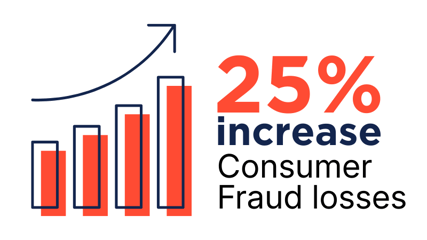
The financial impact of fraud in the United States continues to rise. According to the Federal Trade Commission, reported consumer fraud losses exceeded $12.5 billion in 2024, an increase of approximately 25 percent year over year and the highest level on record.
While based on consumer reporting, these figures reflect the effectiveness of organized fraud targeting the US financial system. Banks absorb much of this impact through reimbursement obligations, charge-offs, investigative cost, and regulatory scrutiny.
 At the same time, suspicious activity reporting remains exceptionally high. The Financial Crimes Enforcement Network reported approximately 4.7 million suspicious activity reports filed by US financial institutions in fiscal year 2024. This sustained volume highlights a familiar challenge: alerts continue to increase, but insight does not scale at the same pace.
For mid-market banks, these pressures are particularly acute. They face exposure to the same organized crime typologies as larger institutions, but with fewer analysts and limited tolerance for inefficiency.
Recent enforcement actions reinforce a consistent regulatory message. The failure is rarely the absence of transaction monitoring. It is the inability to identify, investigate, and escalate related activity across customers, accounts, and time.
Regulators have repeatedly cited fragmented investigations, weak case linkage, and insufficient understanding of customer relationships. In many cases, alerts were generated, but institutions failed to recognize patterns across related accounts or customers or to aggregate risk enterprise-wide.
Across these actions, regulators are not criticizing alert generation. They are criticizing the lack of insight.
Organized financial crime groups deliberately design their activity to evade rules-based monitoring. Transactions are structured below thresholds, activity is distributed across multiple accounts, and roles are divided across networks of individuals and entities.
Money mule networks illustrate this clearly. Individual accounts may appear low risk in isolation. When analyzed collectively, patterns emerge across shared devices, addresses, transaction timing, counterparties, and fund flows. These relationships are rarely visible within alert queues focused on single transactions or accounts.
The same dynamic applies to complex fraud schemes, sanctions evasion, and trade-based money laundering. Criminal networks exploit the fact that most monitoring systems evaluate transactions rather than relationships, creating blind spots that organized crime consistently leverages.
Regulatory guidance increasingly emphasizes investigative quality, context, and judgment. FinCEN has made clear that banks are expected to conduct risk-based investigations and submit suspicious activity reports that reflect an understanding of broader activity, not isolated events.
Examiners now assess whether investigators can articulate how customers, accounts, and transactions relate to one another over time. They expect institutions to demonstrate how risk was assessed, how decisions were reached, and how potential networks were evaluated.
Transaction monitoring systems generate alerts, but they do not provide the analytical framework required to meet these expectations on their own.
To address organized financial crime, banks must complement transaction monitoring with advanced investigative analytics.
At the investigator level, tools such as i2 Analyst’s Notebook enable analysts to integrate data from multiple systems, explore complex relationships, and analyze behavior over time. Alerts become starting points for deeper analysis rather than isolated tasks.
At the organizational level, shared intelligence environments such as iBase allow investigative outcomes to persist beyond individual cases. Teams can access previously identified networks, known actors, and relevant context as new alerts emerge, reducing duplication and improving consistency.
Together, advanced analytics and shared intelligence transform transaction monitoring from a volume-driven process into an insight-led investigative capability.
Financial crime risk in US banking continues to grow, and regulatory scrutiny continues to intensify. Public data and enforcement actions point to a clear conclusion: transaction monitoring alone is no longer sufficient to address organized financial crime or meet regulatory expectations.
Mid-market banks that augment monitoring with network-centric investigation and enterprise-wide analytical governance are better positioned to detect, understand, and disrupt organized activity. They are also better equipped to demonstrate effectiveness, consistency, and accountability.
Transaction monitoring identifies suspicious activity. Network-driven investigation is what enables banks to stop organized financial crime.
See how i2’s market-leading solutions are used globally in some of the most demanding operational environments. Request a demo to explore how they support real-world decision-making.





© 2026 i2 Group / N. Harris Computer Corporation. All trademarks owned by N. Harris Computer Corporation.
1 Cambridge Square, Milton Avenue, Cambridge, CB4 0AE, UK